Showing posts with label cities. Show all posts

Monday, August 17, 2009

Be A Smart Rider

Do you ever have one of those weekends where it seems like things are just not going to go right for you? I had one of those this past weekend.

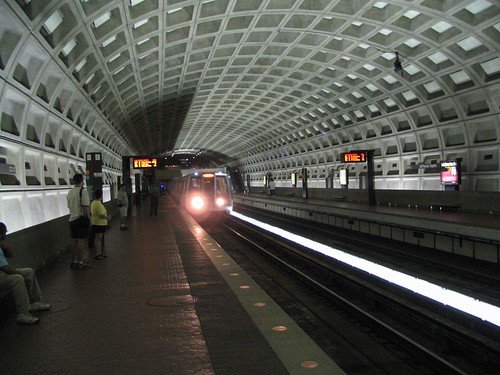
An incident that happened to me this weekend that just did not help the way things were going for me is that I am almost positive that on my way home on the Metro, someone swiped some money and my Metro card out of my purse. It was a crowded train and I had these two things when I got on the train and could not locate them when I got off.

Even if someone didn't steal these item, I thought it would make a good blog post to talk about ways you can be safe when traveling in the city, particularity on mass transit like the Metro or Subway.

Here are some helpful tips, most of which are from Frommer's travel guides :
  • Make sure to bring enough fare. Bring more than enough, in case you get on the wrong train and have to take another or the fare is more than you think.
  • If you feel uncomfortable due to another rider(s), trust your gut instinct and move to the last door of the car. When the train arrives at the next station, get out of that car and into the next car. DO NOT GO BETWEEN CARS. It is dangerous and against the law. and have to take another or the fare is more than you think.
  • Keep your wallet in your front pocket, or if you carry a bag, keep your wallet on the bottom of your bag.
  • Cross camera and purse straps over one shoulder, across your front, and under the other arm.
  • Keep bags in your lap or between your feet, with one foot through a strap and up against the bag itself.
  • Carry money in several pockets, so if one is picked, you won't be without cash.
  • Avoid subways late at night, and splurge on a cab or take a bus.
  • Crowded subway cars can be perfect breeding grounds for antisocial behavior. Some people will use this opportunity to touch or pinch other passengers close to them. If this happens to you, make a fuss in any language you choose. Point at the offender and chastise them in a loud voice. The offender will probably just slink away.
Hopefully these tips will come in handy for you and you won't end up like me without a Metro card and missing a few dollars.

Photo courtesy of Brent and Marilynn on flikr.com

Tuesday, June 30, 2009

Celebrating Our Foremothers: Jane Jacobs

If you haven't already noticed from some of my other posts, I love cities. However, the highly male-dominated field of urban planning is a lonely place for a woman. Jane Jacobs is an exception to this rule and a true leader in the urbanist movement (and an inspiration to me). Her attitude towards combating urban issues like poverty, crime and racism have greatly influenced how I see the problems faced by people who live in cities.
Jane Jacobs is an American-born Canadian urbanist, writer and activist. She was born in Pennsylvania in 1916. She studied at Columbia University's School of General Studies where she took courses in a wide range of topics including geology, zoology, law, political science, and economics.

In the 1950's and 60's, Jacobs really claimed her own vision as an urbanist. During this time she was instrumental in organizing grass-roots efforts in New York City to block Urban Renewal projects that would have destroyed local neighborhoods. One famous campaign Jacobs fought was in opposition to another famous urbanist, Robert Moses, and his building of the Lower Manhattan Expressway that have would divided local neighborhoods, which she was successful in stopping.

Jacobs is best known for her 1961 book, The Death and Life of Great American Cities, in response to US urban renewal policies of the 1950s. Unlike the mentality of the time to simply bulldoze and demolish crippling cities and neighborhoods, Jacobs advocated the end of zoning laws, which would help to create dense, mixed-use neighborhoods resulting in diverse and vibrant urban community. She went on to pen 6 more books including The Economy of Cities and Dark Age Ahead.

In 1968, Jacobs moved to Toronto where she quickly became a leading figure in her new city and helped stop the proposed Spadina Expressway. She was selected to be an officer of the Order of Canada in 1996 for her achievements in writings on urbanism. Additionally, the Community and Urban Sociology section of the American Sociological Association awarded her its Outstanding Lifetime Contribution award in 2002.

In 2006, Jacobs died at the age of 89. Although this very influential woman is gone, her ideas of how cities and neighborhoods should operate lives one. Through her work, she kept the citizens of the communities and neighborhoods she worked with at the center of everything she did.

Jacobs was an urbanist who cared about the communities, not just the big business cities. The principles she followed in her urban activism are some that I hope that I can also adopt in my role as an urban activist. Jacobs' philosophy on urban living affected the way I live my life to be a more aware and active member of my urban community. I participate in community activities like festivals and clean-ups, read my community newsletter and take a move active voice in discussing issues like infrastructure and schools than I ever did before.

Jane Jacobs is a real inspiration to women who want to find a voice in their urban communities and care about their neighbors and the cultural fabric of where they live.

Tuesday, June 16, 2009

Women and the City

Being an Urban Studies and Women's Studies major, the way that these two disciplines interact out in the real world is something that I am always aware of. Poverty is one such issue where these two areas of study overlap. Much has been written about the rise of urban poverty over the last 60 years. However, it has mostly been written from the male perspective. This viewpoint excludes the unique experiences of women who have to juggle poverty with tending a possible family they might have, trying to find work, and encountering the many barriers that come along with not only being poor, but also being a woman.

With the rise in female poverty and women in female-headed households with no spouse experiencing higher rates of poverty at 24.4%, the need for a female perspective is more than evident. Finally, this trend is changing. With new publications that include a female voice in the history of urban poverty, such as Dr. Lisa Levenstein's book A Movement Without Marches, women's experiences and struggles are now being reintroduced into the history of urban poverty.

By rewriting and including women in the dialogue of urban poverty and it's history, effects of this can be seen through many cities new policies and approaches to reducing poverty levels. Places all over the world, including the United States, are starting to follow the idea that by uplifting women in urban centers through promoting gender equity and equality, making education universally available and meeting reproductive health needs, that it can help alleviate many of the factors that lead to rises in poverty. With the Obama administration, they have begun revamp and increase the amount of Small Business Administration programs that provide capital to women-owned businesses.

Women are finally being recognized as an integral part of the way cities function and are being seen as a solution to some of the issues that are a part of cities. This recognition is not only a bright sign for the future of cities and the alleviation of poverty, but is a huge step in getting the female voice in all aspects of social, political, and economic life that has been missing.