Showing posts with label global feminism. Show all posts

Tuesday, April 13, 2010

Taking Action for Women this Earth Day

Earth Day is right around the corner this month - are you ready? Here at FMF, we think the environment is a feminist issue. If you haven't already planned an event for campus, have no fear, there's still time. Get started by taking a minute to check out FMF's Women and Climate Change Campaign!

According to experts, water will be the first resource majorly impacted by climate change. Though we all feel the effects, the world's poorest populations have to face the stark reality of our environmental crisis on a daily basis.

Did you know that women are disproportionately affected by lack of water access? Because many water-related tasks such as cooking, cleaning, and laundry fall to women in the developing world, lack of access to water or poor water quality have negative impacts on women first. Environmental factors like water-borne illnesses and drought contribute to keeping the world's poorest populations trapped in a cycle of poverty and inequity.

So What Can You Do?

This Earth Day, take the opportunity to make sure your community is educated and taking action. A great way to focus your activism is to concentrate on the United Nations Millennium Development Goals (MDGs). Call or write your lawmakers and ask them to support a renewed commitment to meeting the MDGs by 2015. While all the goals need to be a priority, here's some key talking points on a few of them in case you aren't familiar:
  • Goal #3 promotes gender equality and empower women
  • Goal #5 would improve maternal health - a critical need today. Check out our new global materials about maternal mortality for more information!
  • Goal #7 ensures environmental sustainability, access to safe, potable drinking water and sanitation.
Our Women & Climate Change action ideas (available on the web and in PDF) pamphlet has some fun ways that you can call attention to climate change and put a feminist spin to it. Here's a few highlights:
  • Use a poster campaign near water sources to remind people how much we take for granted our access to water! A simple sign like: "The average woman walks 6-9 miles to get to water. And then has to carry it back." by the drinking fountain will make people think twice.
  • Walk for Water Access – Have people physically walk and carry water (or an equivalent weight) a representative distance on campus. To make it more fun and interactive, host a race and challenge people. See how long it takes them to make the trek and subtract points for water lost en route.
  • On-Campus Conservation – Start a campaign on campus to conserve water and get your campus to “go green.” Meet with administrators and different offices on campus with specific goals and develop a plan for meeting them!
Again, for more suggestions on how to bring an Earth Day event to your campus, check out the whole list of action ideas. Contact your campus organizer if you need help planning your event, and let us know how it went! We'd love to get your feedback.

photo courtesy of wwworks on flickr
.

This article was featured in our April 2010 monthly Choices eZine. Sign up for our alerts to stay up-to-date with the latest feminist news and to receive the monthly eZine!

Thursday, February 4, 2010

Gearing up for International Women's Day

In a little over a month - on March 8 - International Women's Day will be upon us! I get excited about International Women's Day each year, because, let's face it, there are a lot of days on our calendars that celebrate old, mostly white men and their achievements. It's nice to have a few days a year where we can collectively celebrate the strides women have made and look forward to the things to come!

So, don't let this opportunity pass you by! This is a feminist campus organizer's dream! A ready-made day, right at the start of women's history month, to put something fabulous together for your campus.

The one thing I'll say is, whatever you do for International Women's Day, don't let it stop at awareness. Raising awareness is critical for movement building, but what we really like to see is awareness-raisers paired with action, so that participants can get involved right away and you won't lose their energy right at the door.

There's a lot of key things happening on the international stage for women these days, but I'll highlight a few here. If you want help developing events or action kits for your International Women's Day activities, contact your campus organizer and we'll be happy to help you put something together!

Idea #1: International Family Planning This is one of the most critical issues we face today. As Patrice quoted Secretary Clinton in last month's eZine article, "...one woman dies every minute of every day in pregnancy or childbirth, and for every woman who dies, another 20 suffer from injury, infection or disease every minute."

Despite this, the US is not doing its share to help close the gap between the need for family planning and funding for international family planning (IFP) assistance. Though the Obama administration released funding that the previous administration had previously withheld for IFP, we still fall short of meeting our share as promised in 1994 at the International Conference on Population and Development (ICPD) in Cairo.

If you're interested, be sure to check out some of FMF's resources and campus materials. Some of our friends over at Population Action International, the International Planned Parenthood Federation, and the Guttmacher Institute have some great materials for further background reading.

Idea #2: CEDAW The Women's Treaty, or the United Nations Convention to End All Forms of Discrimination Against Women, was adopted by the UN on December 18, 1979. The United States is the only industrialized country that has not ratified the treaty. The treaty addresses basic human rights of women and has been used around the world as a tool for women and girls to achieve important reforms to reduce violence and discrimination.

If you want to put together an event about CEDAW, it couldn't be easier! FMF produced a really fun, short video, called CEDAW: The Secret Treaty. Contact your campus organizer directly or email campusteam [at] feminist [dot] org and we'll send one your way. Use the DVD to get people fired up, host a discussion afterward, and pass around legislative phone numbers, fact sheets, or petitions to get people taking action right there.

This is certainly not the limit or even a cursory glance at the possibilities for your International Women's Day activities. We encourage you to start thinking toward March 8, formulating ideas, and gathering resources. Be sure to be in touch with us if you need any help and to let us know how things are going. We'd love to help bolster your ideas and provide you with more resources you might not know about. Drop us a line or give us a call, any time.

Happy (early!) International Women's Day, everyone!

This article was featured in our February 2010 monthly Choices eZine. Sign up for our alerts to stay up-to-date with the latest feminist news and to receive the monthly eZine.

photo courtesy of atbaker on flickr.

Tuesday, November 10, 2009

FMF at Quinnipiac This Saturday!

FMF's Global Programs Coordinator, aka me, will be speaking at Quinnipiac University's WAVE (Women Activists & Allies Vocalizing Equality) annual gala dinner this Saturday, November 14th.

Check out the flier for the event and spread the word! If you are in the area, make sure you try and attend the event!

Wednesday, October 28, 2009

Iceland Tops Global Gender Gap

The World Economic Forum (WEF) just released its report on the WEF's 2009 Global Gender Gap. Saadia Zahidi, director of Women Leaders and Gender at the World Economic Forum, talks with Bloomberg's Margaret Brennan, my college roommate, about the report's findings. Check out the video and watch Zahidi speak about how around the world, wage gap still remains wide.

Image credit: Sudhamshu on flickr.com

Monday, October 26, 2009

UN takes a stance on defining gender, expands trans' travel rights

These past months have lead to some interesting gains and losses for civil rights based on gender-identification, due to the seemingly unrelated debate on travel and border security.

On August 15th, the transgendered community and its allies felt pushed aside when the Transportation Security Administration put out new travelling requirements that required passengers to provide full name, date of birth and gender when booking flights. Transgendered people found themselves in an uncomfortable situation, having categorize themselves in concrete terms without any options directly applicable to them. It's disgusting how this either/ or policy oozes with a lack of sympathy. It does not take into consideration the difficulties and uneasiness a person goes through trying to match past federal documents with current self-identification.

A couple of months later, strides have been made. The UN and Rapporteur Martin Scheinin made their opinion known in the recent "Protection of human rights and fundamental freedoms while countering terrorism" report. The UN made sure to take a conscious, sensitive and realistic approach by defining the security issues without being biased in religion, race, sexuality and gender. The report contained this purposefully vague definition of gender:

"Gender is not synonymous with women but rather encompasses the social constructions that underlie how women's and men's roles, functions and responsibilities, including in relation to sexual orientation and gender identity, are defined and understood. This report will therefore identify the gendered impact of counter-terrorism measures both on women and men, as well as the rights of persons of diverse sexual orientations and gender identities. As a social construct, gender is also informed by, and intersects with, various other means by which roles, functions and responsibilities are perceived and practiced, such as race, ethnicity, culture, religion and class. Consequently, gender is not static; it is changeable over time and across contexts.Understanding gender as a social and shifting construct rather than as a biological and fixed category is important because it helps to identify the complex and inter-related gender-based human rights violations caused by counter terrorism measures; to understand the underlying causes of these violations; and to design strategies for countering terrorism that are truly non-discriminatory and inclusive of all actors."
Thankfully, the UN has exposed the usually hushed gender-travel links and their disproportionately effects to a person's safety. The studies reveal the disgusting scrutiny innocent transgendered people face when crossing boarders. Many transwomen are subject to tougher indentity documentation clearances and face harassment due to a history of men dressing up as women to attempt to escape a heavy bomb/weapon search.

Critics, like that of Fox News, say that the UN over analysed political correctness and minorities' security (those of women, gay, trans, intersex, etc...) by unnecessarily forcing a progressive definition of gender on the public.

However, here at FMF, we know far too well the reality of humiliation and harassment that "minority" populations face due to security policy. Those least protected under the law are (shock!) those who are most vulnerable to civil rights violations at checkpoints.

We are so proud that the UN could look past previous gender-biases and honestly work towards ensuring safe travel for ALL.
photocredit: transguyjay from flickr.com

Thursday, October 22, 2009

Amendment to Repeal Global Gag Rule Faces Opposition

Obama may have repealed the Mexico City Policy, aka the Global Gag Rule, within days of coming into office, but the extensive damage done to the lives of women and girls as a result of the Global Gag Rule doesn't come and go as easily as the policy itself.

The Washington International Family Planning Coalition (IFPC), in which the FMF and myslef personally are very active, were hearing countless accounts from the ground that even though the policy had been repealed by Obama, large numbers of overseas NGOs are still afraid to start advocating or get involved with any abortion activity out of fear that they would still lose their US funding. This shows how much confusion the back and forth of this policy causes in the field in developing nations across the world. We are dealing with real women's lives here.

The IFPC decided to act. We decided the time was now to start moving on policy that would permanently repeal the Global Gag Rule and stop it from being an Executive Order.

In July, the Senate Appropriations Committee approved an amendment introduced by Senator Frank Lautenberg (D-NJ) that would overturn the "Mexico City Policy." Naturally, this has the Antis up in arms. National Right to Life Committee Legislative Director Douglas Johnson told the Congressional Quarterly that his organization is going to fight the bill.

Once again we see abortion politics playing with real women's lives. The Global Gag Rule must be permanently repealed. This policy is a shining example of US domestic abortion politics spilling onto the international arena, allowing policies that would be considered unconstitutional in the US to be implemented abroad, and killing hundreds of thousands of women as a result by denying them access to a full range of reproductive health services. It is always important to remember that even though the Gag Rule is about abortion, it is at its core about family planning. As a direct result of this policy under the Bush Administration, the US completely stopped shipping contraceptives to the countless countries in the developing world.

As Senator Lautenberg told Congressional Quarterly, his amendment would allow international aid organizations to operate without the uncertainty of constantly changing rules. "Health care providers across the globe should be able to care for the health of women and families without ideological obstacles blocking the way," he said.

We couldn't agree with Senator Lautenberg more. Saving women's lives must always be a US policy priority. The time is now to get rid of this policy once and for all.

Image credit: allyaubry on flickr.com

Thursday, October 15, 2009

Great Opportunities with UN Practicum!

Join governmental and NGO delegations from all over the world for the 54th session of the Commission on the Status of Women (CSW) at the UN headquarters in New York from February 26th-March 6th 2010.

The Practicum offers an opportunity for observing how the UN works to address issues requiring multilateral engagement and coordinated action. Students participate as delegates of the Women's International League for Peace and Freedom, and contribute to the official documentation of both official and informal meetings.

The program is open to women enrolled at any college or university in the United States, and provides ample opportunity for peer-to-peer learning and exploring career opportunities in international relations and advocacy work.

This year's conference promises to be especially exciting because the CSW will undertake a 15-year review of the implementation of the Beijing Declaration and Platform for Action, which the UN General Assembly will also mark.

For more information and applications go to:
or email csw2010@wilpf.org

Application Deadline: Noon on November 15, 2009

Image courtesy of www.un.org

Thursday, September 17, 2009

Register for the Women of Color Conference Today!


Have you registered yet for the Women of Color Conference?

With only 8 days left to take advantage of Early Bird Registration discounts (only $15 for individuals, and a measly $12/person for groups of 5+), there's no time to wait! Register today!

Check out our preliminary conference schedule...

Friday, October 9, 2009
12:30-1:30 Registration
1:30-3:00 Conference Opening: Are We There Yet? An Intergenerational Dialogue on the Future of Feminism
3:00-4:30 SpeakOUT at Market Friday
4:30-6:00 Dinner
6:30-8:30 Conference Kickoff Event


Saturday, October 10, 2009
9:00 Registration
10-11:15 Opening Plenary - The Power of Many: Building a Progressive Coalition for Public Health
11:30-12:45 Breakout Session 1
  • More Than Just Safe Spaces: Countering Violence Against Young Women
  • Feminism Speaks for Me – Or Does It?
  • Barriers to Family Planning in the US and Globally
  • This Movement Could Save Your Life: Making Sense of Healthcare Insurance Reform
12:45-1:45 Lunch and optional Teach-In session
2-3:15 Breakout Session 2
  • With Justice for All? Decriminalizing Immigrant Communities
  • Access Denied: Anti-Abortion Terrorism and Threats to Women’s Reproductive Health
  • What’s Next? Global Reproductive Health and Rights in the Obama Era
  • Taking It Into Our Own Hands: The Power of Alternative Media
3:30-4:45 Breakout Session 3
  • Professional Activism and Working in Nonprofits
  • Reproductive Rights are Civil Rights: Guaranteeing Reproductive Justice in Our Communities
  • Facing the Pandemic Here and Abroad: HIV/AIDS in Communities of Color
  • Enslaved in the Shadows: Human Trafficking In Your Community
5:00 Closing Plenary - The Movement of a Lifetime: Living Your Feminism After College

Conference schedule subject to change - there are more details to come! Please check back for updates!

Thursday, July 23, 2009

Humanitarian Funding FAIL

According to commondreams.org, on Tuesday, the UN reported a large gap in their humanitarian funding. A $4.8 billion gap, which is less than half of what it had asked for. The areas most impacted by this shortfall include Sudan, Zimbabwe, the Democratic Republic of the Congo, Somalia, and Pakistan.

This gap in funding comes from an increased need for help in Pakistan and economic problems in many countries. While there seems to be less money available, there is an increasing need for relief to help people find clean water, food, shelter, and the other basic needs for survival.

Women desperately need aid because of their role in the family and their direct connection to their environment. Women are often the people who go to get water for their families, and so they are often the first hit by water-bourne infections and diseases. There's also a great need for improved maternal and women's healthcare in the world.

In order to help these women, and their families, there needs to be an increased focus on the important issues in their lives and a corresponding change in policy and funding. These are the lives of millions of real people.
Photo courtesy of www.flickr/lukeredmond

Tuesday, July 21, 2009

Immigration: Adding a Woman's Face


Last Friday, the FMF co-hosted an event with New American Media, CHIRLA (Coalition for Humane Immigrant Rights of Los Angeles), and various other human rights organizations (i.e, CAST-Coalition Against Sex Trafficking, Asian Pacific American Legal Center, and the National Korean American Service and Education Consortium) to discuss a popular issue in America: immigration policy.

Whenever immigration is brought up in politics, the mainstream media usually portrays xenophobic stereotypes about immigrants, particularly of men, along with politicians complaining on how they are taking away jobs and resources from American citizens. This forum, however, shattered the perceived notion of immigation and brought forth a new perspective, often forgotten in the discussion of immigration and homeland security: the immigrant woman.

Sergio Bendizen of Bendixen and Associates, with New America Media, presented their findings on immigration through a multilingual poll, and brought forth information which polls in America often overlook or dont consider. In addition, these findings also bring a woman's face to the issue. And when citizens and politicans see a face attached to an issue, more work is done to reform the problem.

For instance, according to the conducted poll, the majority of immigrants coming to America are women (51%), and almost 19 (18.9)million immigrants living in the United States right now are women. And, contrary to popular belief, few immigrants come to America for pesonal economic gain (17% of respondants), but to unite with families (38%)and provide a better life for them (22%). (Poll: http://newamericamedia.org/news/view_article.html?article_id=01ab6bae8ae4fa2ac4b9265608901b9e)

These findings are not only important in addressing the immigration issue, but the diversity of feminism. Through researching,we can see how these issues affect women and connect to feminism (ie, language barriers in education, access to healthcare, citizenship obstacles). And the more we understand the immigration issue from a human and feminist perspective, and not just from an economic and political standpoint, the better equipped we are to reform immigration to a more humane and gender friendly nature

Wednesday, June 24, 2009

Women in Action: Iran's Second Wave?

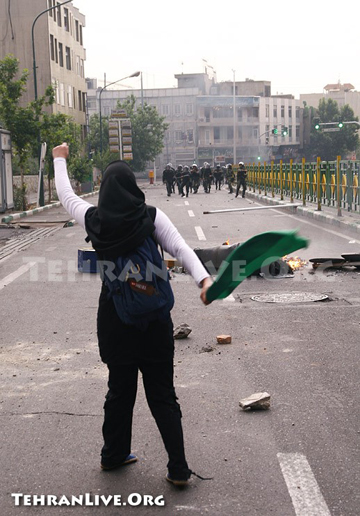
I've been following the situation in Iran over that past couple weeks as I write about it for FMF's Feminist Newswire. For me one of the most intriguing aspects of the pre- and post- election politics is the incredible importance of the women's rights movement. This aspect of the situation is not readily evident in most media coverage of the turmoil, but our FMF Global Programs Coordinator, Anushay Hossain, has kept me up to date with news reports that show how women are shaping the political landscape of Iran.

First of all, women's rights were a big issue in the presidential race. Women make up about half the electorate in Iran, and Ahmadinejad's administration had good reason to fear that they would use their votes to elect a reformist candidate who would support granting women more rights. The Christian Science Monitor's Editorial Board went so far as to suggest in an excellent op-ed that this fear may have motivated the alleged election fraud: "The [women's] movement's courage to confront the patriarchal theocracy (in which 'morality police' still roam the streets looking for women with make-up) may have been a big reason why the regime rigged the vote count--and why supreme leader Ayatollah Ali Khamenei was forced to make a show of ordering a probe of the fraud."

In short, women's desire for equality is a powerful force in Iran, and it's making the government extremely nervous. Journalist Diane Tucker agrees with this assessment: "The regime in Iran obviously feels threatened by peaceful female activism. They branded as illegal the One Million Signatures Campaign initiated by women's rights groups in Iran, a campaign to change discriminatory laws against women...Dozens of women involved in the effort have been harassed or jailed by the government."

Of course, the current police violence in Iran shows just how much Ahmadinejad's regime feels threatened by protesters, women and men. Annie Applebaum writes: "The Iranian clerics know that women pose a profound threat to their authority, too: As the activist Ladan Boroumand has written, the regime would not bother to brutally repress dissidents unless it feared them deeply."

These analyses emphasize just how relevant and powerful the fight for women's equality is in Iran and around the world. Here in the US many young women believe feminism is passe; our generation was born a decade after the Second Wave movement and we tend to take its hard-won victories (and those of the First Wave) for granted. Many never give a second thought to the grassroots organizing, courtroom battles, and debates in the halls of Congress that got us to where we are now.

Now, we are all witnesses to an extremely high-stakes struggle for rights in Iran. Luckily the US women's movement progressed peacefully; it seems that change in Iran might come only after a protracted and violent struggle with the government.

If you're interested in learning more about the women's movement in Iran pre-election, check out this engaging article by UK journalist Katherine Butler. I also recommend the graphic novel memoir and film Persepolis, in which Iranian ex-pat Marjane Satrapi details her childhood spent under the oppressive atmosphere of the Iranian revolution.

Thursday, June 18, 2009

Pandemic, Shmandemic--What about THE Epidemic?

It's very interesting how the H1N1 virus has received so much media attention over the past several weeks. Heads of states and our most prominent global health watchdog, the World Health Organization, have done countless interviews and released statements recognizing this virus as a pandemic. Among numerous epidemics--i.e. hunger, poverty, corruption, AIDS, etc.--the media seems to capitalize on what seems to be a convenient story at the present time.

Well, I'd like to take a moment to highlight an epidemic that has been a part of the human race since the very existence of war, power, and control--sexual violence. In a recent article in the UK's The Guardian, a survey recently conducted by the Medical Research Council in South Africa found that a quarter of men have admitted to committing rape. An overwhelming majority of those who admitted to committing this sexual offense have also claimed that they carried out these assaults before the age of 20. Think that's pretty frightening? Well let's not forget the many women who have fallen victim to "corrective rape" in the country because of their sexual orientation.

But that's just in one part of the world. In Tokyo, women commuting by train are demanding for women-only carriages to avoid unwanted groping. Approximately 2000 arrests were made in 2007 for cases of groping.

Then of course in the U.S., the Senate Judiciary Committee held a hearing Wednesday, June 10th to discuss the continued importance of the Violence Against Women Act (VAWA). Among the panelists, Actress, Gabrielle Union, and Acting Director of Office on Violence Against Women in the DOJ and others gave testimonies that highlighted issues of police response, funding for preventive programming, and shared victim/survival stories. Union offered her personal experience as a rape survivor, and strongly advocated for more funding for better preventive measures.

We know the alarming stat's and we've heard too many stories, so what can we do to make a global impact on this epidemic? Well for starters, call your local representative and urge them to get the U.S. on board by ratifying the Convention on the Elimination of All Forms of Discrimination Against Women (CEDAW). In doing so, the U.S. will be legally bound to practice the provisions of the treaty. Because our country is still supposedly and arguably a super powerhouse of the global community, we can offer some legitimacy to the Convention by which the entire world would may seek to take on this issue more vigorously.

Let's demand more aggressive attention toward one of our gravest wars yet unmet--violence against women!

Monday, June 15, 2009

All Eyes On Iran

I have been following the news on Iran obsessively for the past few days. The developments have been gripping to say the least. I am so overwhelmed by emotion, it is difficult to keep up with the pace at which things are developing on the ground in Tehran.

There are news and images of young people and women being beaten with clubs. Iranian authorities are doing their best to throw out all foreign press, (NBC, ABC, and BBC have all either been asked to leave or had their offices raided), and block websites such as Twitter and Facebook in an effort to seal off as much information coming out from Iran as possible. It's not working.

Last week we analyzed the role of women in these elections, how candidates were wooing their votes as women make up half the electorate in Iran. But all one had to do really was look at the images pouring out of Tehran to see who composed the crowds: young people and women.

Since the announcement of incumbent President Ahmadinejad as the winner of the elections, all hell as broken loose in Iran. I say that with no exaggeration. It is also not an exaggeration to say that there has not been this kind of widespread dissent seen in the country since the 1979 Islamic Revolution.

I think it is easy to get diverted by who won this election, but it is important to focus on what this election is really about: The passion and vigor with which Iranians have taken to the streets to let their government know that they want progress, democracy, change.

Read the signs that people are holding up in rallies. What we have seen in the past few days coming out of Iran disproves the notion that the people of Iran support the Islamic Regime, and want their repressive laws.

I want to avoid this post of mine from getting overtly political, as hard as that is for me. Instead I will leave you with this video. It touches upon a lot of issues, but mostly it highlights how blogs have given a voice to the youth in Iran, and how young people, and people in general, around the world want the same things.

Enjoy and keep the youth and the women of Iran in your thoughts.

IRAN: A Nation Of Bloggers from ayrakus on Vimeo.

Thursday, May 21, 2009

That Time of the Month Around the World


I was so happy when my colleague pointed out this recent piece by the fabulous NY Times reporter Nicholas Kristof. He never seems to miss a beat when is comes to drawing attention to women's reproductive health and rights around the world, and the array of barriers women face in accessing adequate care for their health. A fervent follower and reporter of maternal health issues, Kritof usually highlights factors which contribute to the crippling maternal mortality ratios in developing nations such as Africa. Recently though he has picked up on how periods and lack of access to sanitary products is keeping girls out of school. Read his piece on the issue here.

I am just so thrilled he has picked up on this because it is not just serving as a barrier between girls and education in Africa. In South Asia in countries like India, Pakistan and Bangladesh access to sanitary products is a massive issue that links all different kinds of issues with women's health, like clean water for example. In the villages of Bangladesh and across the continent, women often use rags (usually the borders of their old saris) as sanitary napkins. Because they often do not have enough rags, women share them amongst each other. Because there is no clean water, they are washed in polluted water leading to a host of health issues such as urinary tract infections which can lead to kidney infections if left untreated.

I have heard of huge westerns sanitary product companies like Tampax and Always using this problem as a way to market their product. But there is a huge environmental factor that these companies are not considering. In rural areas, being able to recycle and reuse materials is a major component of village culture. Livelihoods are very intimately tied to the environment. How are women and girls meant to dispose properly of products which are 3-5 part plastic? I know that people back home in Bangladesh immediately reject products they deem wasteful. In fact, shampoo companies often market their products in smaller packages for their rural clientele.

There is a great Indian organization called Goonj that collects rags to deliver to women in villages. I think it's a great initiative because it encourages reusing rags and does not harm the environment. This kind of program is much more compatible with rural life than throwing wasteful and western products with no regards to rural people's lifestyles.

Hopefully with Kristof highlighting this issue in his column, the attention will encourage people to get more involved. It is 2009 and in no part of the world should a woman or girl's menstrual cycle come between her and her education- or anything else she may desire.

Check out the organization when you have time and also have a look at FMF's Women and Climate Change Campaign.

Monday, May 18, 2009

Global Feministing


I just posted a piece I wrote for a publication back home in Bangladesh on the 15th Anniversary of Cairo on the Feministing Community Blog. Check it out when you have time! There's a disclaimer at the bottom, but please know and remember that the views on my blog post do not represent those of the Feminist Majority or the Feminist Majority Foundation :)

Friday, May 15, 2009

The Might of Burma's Aung San Suu Kyi

When I was growing up in Bangladesh, Burma's Aung San Suu Kyi never ceased to amaze me. Burma is right next door to us geographically, but as a little girl all I understood about the military junta in Burma was primarily through pictures. I couldn't wrap my head around what kind of threat this tiny woman with bright and colorful flowers always tucked behind her ear posed to these big men with guns. Clearly the military's worries went beyond what Suu Kyi represented to them physically. This woman embodies the heart and the spirit of the much oppressed movement for democracy in Burma.

In my adult years, it has been increasingly difficult to keep track of Suu Kyi's imprisonment which has been constant, continuous, and lasted well over a decade. Forced to be a prisoner in her own home, Suu Kyi was well known to be a fighter, and being imprisoned had done little to crush that spirit. But in the past few years, Suu Kyi has become increasingly silent which many have credited to her ailing health.

We were actually just weeks away from what was meant to be her release. However, recent developments not only mean that Suu Kyi will not be released, but moved out of her home and into one of Burma's notorious federal prisons.

Take the time to read a piece by one of my favorite Guardian (the UK' s version of the NY Times) colomnists who articulates this complex issue much better than I ever could. Read for yourself how the spirit of one woman singlehandedly poses the greatest threat to Burma's military junta. Be informed and be inspired. We must maintain pressure on the US Government to not let Suu Kyi disappear from the world's consciousness. She is the only hope the people of Burma have to be a nation of democracy.

Tuesday, May 5, 2009

Pressing Issues Raised at the Global Women's Rights Awards and What You Can Do About Them!


Each year, the Feminist Majority Foundation honors extraordinary people who have overcome great obstacles, adversity, and threats to their own lives and well-being to expose global women's rights injustices and fight for women's rights worldwide. Last Wednesday evening I had the pleasure of attending the 5th Annual Global Women's Rights Awards.

Amidst the sold out ballroom, the almost rowdy live auction hosted by Jay Leno, and the bustling Ms. Obama poster and Afghan craft sales, I couldn't help but be in awe of the fact that I was mingling with truly incredible, beyond inspirational, groundbreaking, unrelenting feminist honorees.

Christiane Amanpour, CNN's Chief International Correspondent, took a stand when no one else would and exposed the horrendous conditions the Taliban was, and continues to inflict upon women and girls in Afghanistan. Afghan women and girls lack access to the most basic human rights: to leave the home, earn money, visit the doctor, and go to school without facing atrocious cruelties such as acid attacks. The situation for Afghan women and girls is not improving but with the help of brave women like Christiane Amanpour and yourself, we can make sure the international eye is watching the plight of Afghan women and girls. Sign online petitions and help raise money to train an Afghan midwife and reduce maternal mortality rates in Afghanistan.

Dr. Neal Baer (Executive Producer) and Mariska Hargitay (as Detective Olivia Benson) have brought hard-hitting women's issues to primetime television through Law & Order: Special Victims' Unit for over eight seasons. Through bringing the all too real issues of hate crimes, sexual assault, domestic violence and the backlog of rape kits in Los Angeles, among many, to mainstream media, Baer and Hargitay have helped raise awareness, raise outrage, and have helped prompt viewers, activists and lawmakers to fight against these all too prevalent occurrences.

Last but not least, the remarkable and inspriring team behind the film, Pray the Devil Back to Hell, was honored. Produced by Abigail Disney and directed by Gini Reticker, Pray the Devil Back to Hell tells the story of Leymah Gbowee and the thousands of other Liberian women who organized peacefully to end a gruesome civil war and elect the first female head of state. The story is one of peaceful activism, grassroots organizing and powerful feminism at its finest. Disney and Reticker, through the production of this film, have helped ensure that the story of how women have shaped a country's history does not go unrecognized or rewritten through a patriarchal lens. Spread the inspirational story of the Liberian women and celebrate women's collective successes by hosting a screening of Pray the Devil Back to Hell on your campus.

This Is What a Pakistani Woman Looks Like

With the Obama Administration's newly coupled policy in Afghanistan and Pakistan, those countries are pretty much a regular fixture on our TV screens. But what about the women? Yes, the resurgence of the Taliban and implementation of Shariah Law in the SWAT region are all major and real threats to women's rights in the region. But there is more to the women who live there then just the images of victims we are so use to seeing, and so regularly reinforced by the media. I have something for you to break those stereotypes.

Here is a blog post by Fatima Bhutto, the niece of assassinated Pakistani Prime Minister Benazir Bhutto. Beyond the violent deaths that define this family dynasty (Fatima's father was "mysteriously" killed in front of his home) is the articulate voice of a young woman whose perspective into the politics of South Asia are really not
hing less than a treasure.

Read:

http://www.thedailybeast.com/blogs-and-stories/2009-04-26/stop-funding-my-failing-state/

Watch:


Monday, May 4, 2009

One Night Only: FMF's Fifth Annual Global Awards

6am flight from Washington Dulles non stop to LAX for one night only. What would you do if you had that ticket in your hands? Well, if it was to attend the annual Feminist Majority Foundation's Global Women's Rights Awards in Los Angeles, you would have your bags packed in 5 minutes flat! And that's exactly what I did.

Beyond the overwhelming glamor of the event was a cause that couldn't be farther from the opulence of the setting at the Beverly Hills Hotel. For the last five years, FMF has held these awards in LA to honor the immeasurable courage of women who risk their lives to fight for women's rights.

This year's awards addressed how women in the US are mobilizing to protect the lives of women in Afghanistan and Pakistan, and media pioneers whose work brings us the stories of women and girls around the world. With the recent resurgence of the Taliban and the US's renewed and newly coupled strategy in the region, FMF knew the time was
now to breathe new life into our Campaign for Afghan Women and Girls, formerly the Nobel Peace Prize nominated (2002) Campaign Against Gender Apartheid in Afghanistan.

The three hour event, hosted by Mavis and Jay Leno, started with a live auction, followed by dinner and a panel discussion featuring the honorees. The list of honorees read like a roll call of some of the most amazing women in the world: CNN's Chief International Correspondent
Christiane Amanpour, Roja Bandari of the Iranian One Million Signatures Campaign, Janet Johnson Bryant of the Liberian Mass Action for Peace, Billie Heller from the National Committee on CEDAW (The UN Women's Treaty), Abigail Disney and Gini Reticker, producer and director respectively of Pray the Devil Back to Hell.

Beyond the glitz and glamor, at the core of the event was the fact that the return of the Taliban has brought a brazen military assault on the women of both Afghanistan and Pakistan. Shariah Law has been introduced in the SWAT province of Pakistan; acid attacks on girls going to school in Afghanistan are rising. The possibility that women's rights in these countries could roll back to the Dark Ages is a real and palpable threat. Unless women, both here and around the world, say NO: Not on our watch. And that is exactly what FMF President Eleanor Smeal urged the audience to do.

Christiane Amanpour spoke at length of her past and recent travels to Afghanistan, and shared with us her stories of the women she met there. Amanpour said that the Afghan people had helped the US fight and defeat the Taliban post 9/11, and paid with the destruction of their country and the deaths of countless civilians. She said
every woman in Afghanistan is strong, every woman struggles. And when asked what the one thing they want the most for their children, Afghan women all say education. Before food, before health care, before security, she said they all stipulated that without education, the children of Afghanistan would not have an opportunity to determine the course of their own futures, and to lead lives better than those of their parents.

All I could think about were the words of Afghan feminist and activist Dr. Sima Samar who was recently in our Washington office recounting stories of young girls being burnt by acid on their way to school, having their teachers shot in front of them by the Taliban- she had no shortage of horror stories. Except for the fact that they weren't just stories: They were real accounts of what was happening in Afghanistan everyday. We simply cannot forget the women of Afghanistan again. Losing in Afghanistan would be detrimental to every single women's rights movement in the world.

Iranian activists Roja Bandari and Yasmin Manaucheri accepted FMF's award for their Million Signature Campaign on behalf of their sisters in Iran. Although they head the campaign in the US, they dedicated the award to their colleagues in Iran who have been subject to endless harassment and arrest by the Iranian government for more than two years because of their online campaign for women's rights.

The work of each honoree made me reflect on the amazing the spirit of the global women's movement. No matter how oppressive a regime is, be it in Iran or Afghanistan, a women's movement resisting the oppression exists. Be it underground or out in the open, resistance is there, women are organizing. I have no doubt that the spirit of these global movements have the power to win. But we must fight alongside with them. After all, our futures and destinies are interdependent with theirs- now more than ever.