Showing posts with label suffrage movement. Show all posts

Tuesday, August 24, 2010

Women's Suffrage: A privilege, not a drag

This year's rapidly approaching Women's Equality Day, August 26th, provides an interesting means of reflection. Looking back over ninety of the most eventful years of human history, it is incredible to see what women have accomplished. Women in science, politics, literature, journalism, business, and a multitude of other professions have without question changed the world, and advanced human understanding to an incredible amount. When one considers all that has happened as result of women, it is hard to believe that just ninety years ago, women did not even have the right to vote.

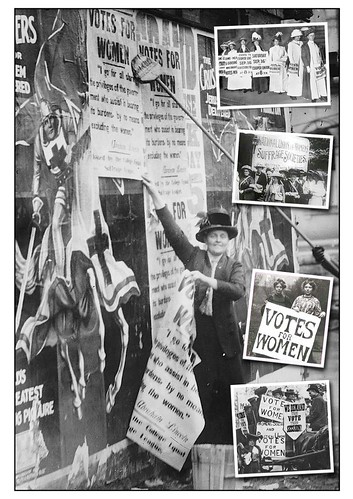
The fight for suffrage is a famous one, yet many do not know the degree to which women were terrorized, tortured, and endangered as result of their conviction, their collective quest for political voice. Suffragists (as 'suffragette' was originally used as a derogatory term) were horrendously beaten by police and hostile observers of their peaceful protests and White House pickets. In prison, suffragists were even more badly abused. Hunger strikes were dealt with by force-feeding, like in the case of Alice Paul, while other women like Lucy Burns and Dora Lewis were also brutally mistreated by prison guards. Conditions in prison were awful for the suffragists. In one case, women at the Occoquan Workhouse spent several weeks using only water that came from an open pail, and eating food infested with worms.

What would these women think now, seeing their daughters, granddaughters, and great-granddaughters forsaking the precious right that they spent so long fighting for? Voting is a privilege and a responsibility, and the fact that so many women do not take advantage of it is most distressing. It goes without saying that the fight that suffragists fought ninety years ago was an incredibly difficult one. Nevertheless, they fought it anyway, because they could see how valuable, and necessary it was for their growing, changing country.

Modern women need to continue to value their right to vote as much as female suffragists did when they first were granted it. We tend to forget that suffrage isn't something that we were just given. It was something we fought very long and very hard to win.

Thursday, August 19, 2010

Thank You Thursday 08/19/2010

Today we'd like to thank....


  • the suffragists who worked hard to get the 19th Amendment ratified on August 18, 1920, giving women the right to vote

  • American Civil Liberties Union (ACLU) for filing a lawsuit against the high school that removed a girl from the yearbook for wearing a tuxedo in her senior portrait (They removed her name, photo, etc-- she was not mentioned anywhere in the yearbook at all!)

  • French pharmaceutical company HRA Pharma for developing the emergency contraceptive EllaOne

  • Food and Drug Administration (FDA) for approving Ella, giving women in the U.S. another way to prevent unwanted pregnancy

THANK YOU!!!

Wednesday, January 27, 2010

Blast from the past: Suffragist cartoons!

We at FMF are always in favor of singing, dancing educational resources. We're currently assembling the schedule for the National Young Feminist Leadership Conference, which will include workshops on running for office and the legislative process, amongst many other topics.

Consequently, I felt compelled to revisit the classic Schoolhouse Rock animated video I'm Just a Bill, which describes the policy process to children. While poking around online, I was delighted to discover Schoolhouse Rock produced feminist videos too! Sufferin' 'til Suffrage provides a manic overview of the American women's suffrage movement, which of course culminates in winning the right to vote in 1920 with passage of the 19th Amendment.


Want to see more feminist cartoons? The Sewall-Belmont House was the historic Capitol Hill base for Alice Paul's National Woman's Party during the original Equal Rights Amendment fight. In addition to ERA exhibits, the house has a terrific collection of Nina Allender political cartoons supporting the struggle for voting rights that preceded the ERA. Allender's powerful images contributed to the push for women's equality, so check 'em out at the Sewall-Belmont House in person or online.

The Sewall-Belmont House has early feminist march banners, Susan B. Anthony's desk, and many more inspiring artifacts from pioneering women's rights advocates. It is chilling to walk the halls of a home steeped in the movement, where bold women plotted legislative strategies to win progress for American women. Your campus activism will write the next chapter of women's history, so join us at the conference in DC this March as we continue agitating for equality!

Correction: The initial post incorrectly cited the Sewall-Belmont House as the headquarters of the women's suffrage movement. It was actually the headquarters of the Equal Rights Amendment effort headed by the National Woman's Party. Thanks to former FMF intern Caroline Sellars for the tip-off!

Wednesday, August 26, 2009

Guest post: Shelby Knox on Women's Equality Day

To get serious feminist analyst on this fun song, I was struck by the lyrics:

"Our daughters' daughters will adore us. And they'll sing in grateful chorus "Well done, Sister Suffragette!"

As the "daughters' daughters,"are we grateful? And, do we need to be?

Yes, those that find their way to this blog are are celebrating Equality Day and are aware of the struggles of the women before us.

But in reality each generation has made their mark by decrying the shortcomings of the waves of feminism that came before them - the second wave did it to the first wave, the suffragists, by attacking them for focusing too narrowly on the vote. The third wave has done it to the second wave by attacking them for not being diverse enough and for excluding LGBT and male humans from the fight. If this is gratitude, who needs enemies?

I've heard Gloria Steinem say many times that "Gratitude never radicalized anybody. My generation didn't walk around grateful for the vote." She doesn't want our generation's thanks but for us to get pissed off enough on our own behalf to mark our mark on the world. On one hand, I agree wholeheartedly - after all, progress isn't made by focusing on what's already been done.

But, on the other hand, I think being grateful is a sign that we know our herstory, that we take strength from it and stand in solidarity with the women who fought the same fight we are waging now. We obviously have ideological disagreements across and within the generations but our activism comes from the same place of recognizing injustice and embarking on a struggle to fight it.

I've noticed how our generation's feminist lexicon doesn't include the word "sister," probably partly because we don't want to consider the second wave women who still control much of the movement our "sisters." But, I think we could all do with a little more gratitude, both for the women before us and the women beside us, regardless of age or wave, simply because when it comes right down to it we are working for the same end, to quote Mrs. Banks: "Political equality and equal rights with men!"

Happy Equality Day to all my sisters!

Photo courtesy of Shelby Knox.

Wednesday, August 19, 2009

HERstory 89 years in the making...

Yesterday (August 18) marked the 89th anniversary of the Tennessee legislature's ratification of the 19th amendment.

One week from today, August 26 - Women's Equality Day, we celebrate the anniversary of the 19th amendment officially becoming a part of the US Constitution--at long last extending the vote to women!

Now if we can only work on getting equal recognition THROUGHOUT the Constitution...


Photo: Inez Milholland Boissevain seated on a white horse at the National American Woman Suffrage Association parade, March 3, 1913, Washington, DC. Courtsey of flickr.com/Bobster855

Tuesday, July 21, 2009

Where The Movement Got Its Roots

Last Sunday, my fellow FMF interns and I met at our supervisor's apartment to enjoy a brunch of some delicious strawberry shortcakes and to hang out a little outside of the office. While our gathering was quite informal and benign, July 19 marks a historic day in history. On this same date in 1848 when the First Woman's Rights Convention began in Seneca Falls, New York.

This historic event was several years in the making, beginning when such suffragettes as Elizabeth Cady Stanton, Lucretia Mott, Martha C. Wright, and Jane Hunt were banned from participating in the 1840 World Antislavery Convention in England.

Over 300 people came to the first convention, including 40 men. The Declaration of Sentiment, a document declaring the rights of women similar to the Declaration of Independence, was revised and signed at the end of the convention. Great anti-slavery advocate Frederick Douglass also attended and spoke in his favor of women's rights.

However, as we know, all was not solved after this historic day. The press and religious leaders denounced the happenings at Seneca Falls and it took another 60 years just to get the vote. Such documents like the ERA and CEDAW have yet to be approved and ratified by the US. These facts show that the women's movement is far from finished, just evolving.

Remembering this day in history of where, why, and how the women's movement got it's start helps to reminds us why the fight for women's equal rights is so important. Looking back on this event and the bravery and dedication that these early members of the movement had gives me strength and inspires me to continue in my role as a feminist.

Photo courtesy of psd on flikr.com

Wednesday, July 1, 2009

Victoria Woodhull - Ahead of her Time

In 1872, 48 years before women earned the constitutional right to vote, one woman launched her campaign for the US presidency. Though her presidential bid was unsuccessful, Victoria Woodhull, had taken a remarkable leap towards equality for women. A fierce advocate for women's suffrage, Woodhull spoke before the House Judiciary Committee - the first woman to do so - and made a legal case for women voting. She argued that the 14th and 15th Amendments granted women full rights as citizens and that denying them the right to vote was unconstitutional.

Woodhull was also well-known as an advocate for free love. Though it was a controversial idea at the time, she felt that women should be able to have as many sexual partners as they so desired. During a speech in 1871, an audience member yelled out to her asking if she personally identified as a free-lover, to which she replied:

"Yes I am a free lover! I have an unalienable, constitutional, and natural right to love whom I may, to love as long or as short a period as I can, to change that love every day if I please! And with the right neither you nor any law you can frame have any right to interfere."

While we work this week to remember the women who helped shape our country, we should all take a moment to reflect on the unbelievable foresight and achievements of Victoria Woodhull.

Tuesday, June 16, 2009

Prioritizing Equal Rights

Tensions have been high over the past few weeks between the LGBTQ community and the Obama administration. Last week President Obama asked that the U.S. Supreme Court reject the case of James Pietrangelo II, an infantryman dismissed from the Army under the antiquated Don't Ask Don't Tell Policy. A few days later, the Department of Justice filed a brief (full PDF here courtesy ABC news) that supported the Defense of Marriage Act. Fortunately, today, President Obama is set to sign a memorandum granting same-sex partner benefits to federal employees, a move that many hope marks only the beginning of the administration's move towards reform.

With the state of the economy, many pundits have claimed that civil rights of the LGBTQ community are simply not a current priority. Certainly, President Obama has been presented with a tough set of issues to resolve: between pulling out of Iraq and trying to push through health care reform, the President has hit the ground running during his first four and a half months in office.

So where does that leave the LGBTQ community? Are we justified in expecting progress on civil rights when there are other issues bogging down the nation?

Just ask the suffragists: they faced a similar predicament during World War I. When the United States entered the war in 1917, suffragists were faced with a choice: step aside while the nation was at war, or continue to pursue their cause. Fortunately for women today, Alice Paul and other suffragists continued to fight for our rights and eventually were successful with the passage of the 19th Amendment in 1920.

Which brings us back to today. Yes, we are a nation at war. Yes, we are struggling through the worst economic circumstances since the late 1920s. But one thing we've learned from history is that the fight for civil rights takes persistence, even during a difficult time in the nation's history. Unless we demand that LGBTQ rights be a priority in this country, this fight will never be won.