Tuesday, April 12, 2011
Equal Pay Day: Promoting the Rights of ALL Workers
Tuesday, September 21, 2010
Pay equity & CEDAW: How long must women wait?
Gender wage gap
Even though we have anti-discrimination laws, the gender wage gap begins immediately as young women enter the workforce and graduate from college, and it only widens over the course of their career. During her lifetime, a college-educated women will earn $1.2 million less than her male classmate will, just because she is a women. You know the stats.
So what can your feminist group do?
- Learn more. Read about the Paycheck Fairness Act currently before the US Senate, and get the latest wage gap data [PDF] from our friends at the Institute for Women's Policy Research. Discuss the wage gap at group meetings, and how you can take political action on this issue.
- Hold a pay equity bake sale on campus to illustrate the effects of the wage gap and raise some dough (ha!) for your feminist group.
- Work with your campus career center and progressive groups on campus to organize workshops on resumes, interviewing, salary negotiation, and feminist careers. A great off-campus resource is the WAGE Project, which conducts workshops specifically for college women. The WAGE workshop I attended as a student was excellent.
Ratification of CEDAW
The US is one of the last countries that has not signed the United Nations Convention on the Elimination of All Forms of Discrimination Against Women (full text) human rights treaty. This treaty would serve as a full commitment to women's equality under the law, which we still do not have in this country (see also: Equal Rights Amendment).
Ratifying countries commit to:
● Take concrete measures to ensure women can enjoy basic human rights and fundamental freedoms.
● Establish judicial procedures to ensure the effective protection of the rights of women.
● Take appropriate measures to eliminate discrimination against women by persons, organizations or enterprises.
● Submit national reports every four years on measures they have taken to comply with the treaty to protect and promote the rights of women in their country.
The Obama administration and Secretary of State Hillary Clinton support ratification. A vote of two-thirds of the US Senate (67 votes) is required for ratification, and no action is required by the House of Representatives.
What your group can do:
- FMF is part of a broad coalition working toward CEDAW ratification in the US. Learn more at http://www.cedaw2010.org/
- Host a film screening and discussion of FMF's short DVD "CEDAW: The Secret Treaty." Email us at campusteam (at) feminist (dot) org to get your free copy, and use this CEDAW handout to facilitate the conversation.
- Ask your women's studies and international relations professors to cover CEDAW in class.
And remember, vote on Election Day Tuesday, November 2nd!
This was post was featured in the September 2010 campus eZine. To join our mailing list, sign up here.
Tuesday, August 25, 2009
She said what?!
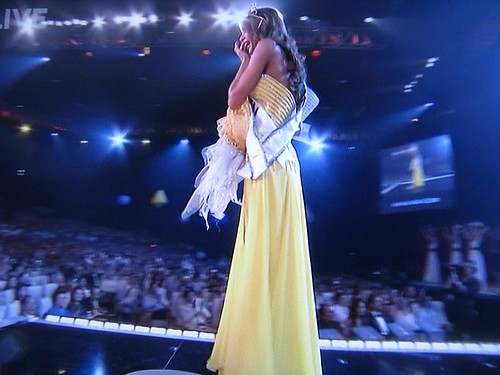
America seems to be obsessed with beauty pageants. With the recent outburst of toddler and teen beauty pageant reality shows that have hit the airwaves (i.e. Toddlers and Tiaras on TCL and Little Miss Perfect on WE), I think its safe to say that our attention has been on beauty, not brains. And it is not just the US, it's the universe!On Jezebel, I saw their recap of Sunday's Miss Universe pageant and found myself saying "did she just say that" out loud in my office. During the question portion of the pageant, Miss Venezuela was asked what women can do to overcome sexism in the workplace. She answered that women need to realize that "there are no longer any barriers against us." Turns out, the judges liked her answer, and she won!
We no longer have any barriers? What about the still ever present wage gap, sexual harassment and encroaching glass ceiling that many women feel constantly in the jobs? Those sound like barriers to me.
I know Miss Venezuela might be talking from personal experience, and if she is, I'm glad that she has not experienced these limitations that many other women feel in their jobs. But it doesn't negate that these are very real issues that women still face today.
Now that Miss Venezuela has been crowned Miss Universe, maybe her new position will allow her to use this influence and celebrity for positive impact on the behave of women. I also hope that people who were watching the Miss Universe pageant Sunday night know that there really still are many barriers for women in the workplace. Usually, the Miss Universe pageant is not where you turn to get good information. Remember the Miss American pageant 2009?
Photo courtesy of stevendamron on flikr.com
Friday, July 10, 2009
Feminist Friday Funday!
Val and I like Bitch Magazine's feminist lolcats, so Val's roommate kindly provide pictures of her cat Daisy.This is my very first attempt at lolcat humor. Enjoy!
Thursday, June 11, 2009
This Day in History: "Ladies running about the streets..."
A special thanks to AAUW and Feminist Majority's Norma Gattsek for this great bit of our Nation's history...June 11, 1870 - On this date, the House narrowly passed an amendment to an appropriations bill prohibiting gender discrimination in the compensation of clerks hired by the federal government. Under the prior law, female clerks earned less than half the salary of similarly employed men.
The bill’s final passage (78 to 74, with 78 Members abstaining) reflected the contentious debate surrounding the measure. In February, Samuel Arnell of Tennessee first suggested that female clerks be paid an equal wage; the House rejected his and similar amendments amidst sarcastic barbs and jeers. Representative Anthony Rogers of Arkansas objected to “these ladies running about the streets and lobbying with members,” predicting that “the upshot of it…will finally place the whole administration of Government under female management.”
Representative John Farnsworth of Illinois countered “that it is unworthy the manhood of this House and the spirit of the age” to pay women lower wages. Other Members noted that many working women were Civil War widows whose wages were their only means of support. The Senate eventually amended the bill to include an equal pay clause. When the measure returned to the House, the Appropriations Committee adopted the Senate amendment; however, the committee effectively weakened it by adding language promising the equal wages only to future employees and by freezing the number of clerkships on the payroll.
The compromise lured support from Members originally concerned about the additional cost of the pay raises, tipping the scale in the close vote. Supporters were optimistic about the amendment’s future effect. “What we call civilization from age to age has brought to man wider freedom, yet little relaxed the iron subjugation of women,” Arnell intoned. “I see in the removal of this disability immediate reform in our social life.”
Friday, May 15, 2009
Feminist friday
Aloha! Hope your spring is galloping along nicely. The theme of the day is 'going the distance.'Rachel Alexandra is one of the favorites to win Saturday's Preakness Stakes race. The 3-year old filly is the only filly in the field, so she has generated a good deal of press coverage. I liked the New York Times's op-ed deconstructing gendered races and measures of success for fillies and colts. We at FMF don't have a position on horse racing, but we wish Rachel Alexandra the best.
Unfortunately, your hard-earned dollars will not stretch as far as they have been. The Times also reported that the cost of living is rising. Food, oil, and gas prices are increasing, so consumers will feel the pinch.
Inflation may be a sign the recession is slowing, but this is still bad news for families, particularly given the poor job market. States facing huge deficits are cutting social safety net programs, which makes folks even more vulnerable to hunger and poverty.
This is why feminism is critical now more than ever. The gender wage gap hurts families. The high costs of insurance and health care mean millions of families go without, which is deeply problematic. The inability for parents to take paid sick days to care for themselves and their families is deeply problematic.
If you agree, then we still need your help. We must make employers and governments go the distance and be responsive to the needs of women and families, especially in a time like this.
Let us know how you're improving your communities. If you need ideas or want to get involved to help women and children here and abroad, visit our website for suggestions or hit us up at campusteam@feminist.org.
Thanks and we'll see you on the flip side.
Monday, April 27, 2009
Equal Pay Day this Tuesday!
Howdy feminists,It's almost 80 degrees and sunny in DC. I'd like to celebrate, but the gender wage gap is getting me down.
Tomorrow, April 28, is Equal Pay Day, but really, every day is unequal pay day for women around the world.
Women earn less than men for the same work and the same hours. The U.S. Census Bureau found women earn 78 cents for every dollar men earn. Black women earn 69% of what white men earn, and Latina women earn 59 cents to every dollar a white man earns.
The wage gap begins as soon as women enter the workforce, and recent college grads are no exception. Additionally, the gender wage gap is apparent in every occupation, as you can see in this Bureau of Labor Statistics breakdown.
The Lilly Ledbetter Fair Pay Act was a great signal to our justice system and policymakers that we will continue to negotiate a more equitable society, and that proactive policies like the Fair Pay Act help women and families. We've made strong gains over the last few decades, but at this rate none of us will see equality in our lifetimes.
Many student groups around the country are working to erase the pay gap and raise awareness on campuses, which is terrific. There are tons of way to get involved.
Tell the students in your group to wear red tomorrow as a reminder the wage gap keeps women in the red. You could host a pay equity bake sale, where women get charged 78 cents for baked goods while men pay $1.
Have fun while educating your campus: the Making Waves group at Southern Illinois University - Edwardsville sponsored a bean-bag toss with prizes. Women stood 7'6" away from the target, while men stood 10 feet away from the target. Students used bras as bean bag slingshots.
Host skill-building workshops on campus on interviewing, salary negotiation, and professional development. Partner with local feminist and progressive organizations to host networking events.
On a national level, you can get involved in the Fair Pay Campaign, a project sponsored by numerous women's organizations, including FMF. The campaign is sponsoring a congressional briefing on pay equity this Thursday, and it's free and open to the public. The briefing will be on Capitol Hill and you can learn more here.
We also encourage you to blog and tweet about how you're working to end the wage gap. Contact campusteam@feminist.org to let us know how you'll commemorate Equal Pay Day, or if you have any questions or suggestions!