Showing posts with label women's history. Show all posts

Tuesday, July 6, 2010

Happy Birthday, Frida Kahlo!


Today is the birthday of Frida Kahlo, feminist, surrealist artist, and socialist feminist icon. She was born in Mexico on July 6, 1907. A polio survivor, Kahlo understood the many difficulties that people with disabilities face today and used art as a catharsis of sorts.

Many of Kahlo's works are self portraits and many of her paintings contain Mexican, Christian, and Jewish symbols.

Kahlo was an amazing artist, feminist, and is also regarded by many as a queer icon. Check out her work sometime, you won't regret it.

To learn more about Frida Kahlo and her works, click here.

Friday, June 11, 2010

Equal Pay Act: 47 Years Later

47 years ago yesterday, President John F. Kennedy signed the Equal Pay Act. According to the Wage Project a professional woman will make $1 million less than a professional man in her lifetime.

I’m going through a phase right now where I’m not quite sure where I’ll end up in 5 years, most likely fighting the good fight in Women’s rights/Human Rights or still in school, but I will definitely be a professional woman, and it really upsets me (putting it lightly) that I could be missing out on ONE MILLION DOLLARS during the span of my lifetime. I mean just think of all the things you could do with some extra cash.

What's worse is that the stats we hear like "A woman makes 77 cents to every dollar a man makes." are not entirely true. That statistic should read something more like "A professional Caucasian woman makes 77 cents to every dollars that a man makes." Statistics can be presented in many ways and unfortunately pay equity statistics, in my opinion, are spun to look like the wage gap is much smaller than it actually is.

What about women and men who work blue collar jobs? How much less do those women make than men? (Correct me if I am wrong, but the statistics from the Wage project do not include these women)

Women of color make significantly less than 77 cents, African American women make 68 cents to every dollar, and Latina women make 58 cents (Que?!) It's just extremely disgusting to think that in 2010 women still get paid less because they are women.

"Because they are women"

Everytime I say this I take a moment to let it sink in, so that I always remember that I am a second-class citizen and that there still is a lot of work left for feminists.

Check out what President Obama said about Pay Equity yesterday.

I found this very interesting link from WAGE "What Are the Costs of the Wage Gap", check it out!

Oh a much happier note! Today Iceland made same-sex marriage legal! Yes! Equality Wins!

Photo Credit: AMagill on Flickr

Thursday, March 4, 2010

The Radical Act of "Writing Women into History"

Women's History Month presents an opportunity to us all to change a historical narrative that places women at the margins of society, and by doing so, change the world.

As the great feminist historian Gerda Lerner once wrote, "What we do about history matters. The often repeated saying that those who forget the lessons of history are doomed to repeat them has a lot of truth in it. But what are 'the lessons of history'? The very attempt at definition furnishes ground for new conflicts. History is not a recipe book; past events are never replicated in the present in quite the same way. Historical events are infinitely variable and their interpretations are a constantly shifting process. There are no certainties to be found in the past." History cannot provide us with all the answers, but it can shape our understanding of both our past and present.

Women's History Month was created thanks to the activism and lobbying of the National Women's History Project (NWHP) and feminists around the country. In 1980, the year NWHP was formed, women made up just 3% of the content in history textbooks, and many children (and adults) assumed the absence of women in history meant that women just didn't do anything. Howard Zinn, the recently deceased historian and activist, wrote in A People's History of the United States that, "It is possible, reading standard histories, to forget half the population of the country. The explorers were men, the landholders and merchants men, the political leaders men, the military figures men. The very invisibility of women, the overlooking of women, is a sign of their submerged status."

Every year Women's History Month has an official theme, and the theme this year is "Writing Women Back into History," which could not be more appropriate. Women's History Month is not about fun facts or random lists of female trailblazers (though I enjoy learning about things like that). It is about changing the way Americans view their society and reshaping our historical narrative. As a kid I remember learning about Betsy Ross, Clara Barton, and Molly Pitcher, held up almost as exceptions to the rule, the women who actually did something. If we want to truly recognize the contributions of women, we need to totally subvert the way we study history. We need to consider not just the history of the rulers and military heroes, but that of the mothers, wives, laborers, slaves, rebels, and ordinary people whose lives were average but real. There is so much to learn from social history. That is not to say we should stop seeking out the stories of extraordinary women (my life has been made so much richer by learning about women like Ella Baker, Emma Goldman, Dolores Huerta, Eleanor Roosevelt, Charlotte Perkins Gilman, Aung San Suu Kyi, and Fannie Lou Hamer), but that to truly be radical feminist historians, we need to discover the stories of the forgotten and pushed aside.

Women's history is the people's history--learn it, share it, and use as a tool to change the world.

This article was featured in our March 2010 monthly Choices eZine. Sign up for our alerts to stay up-to-date with the latest feminist news and to receive the monthly eZine.

Thursday, February 4, 2010

Gearing up for International Women's Day

In a little over a month - on March 8 - International Women's Day will be upon us! I get excited about International Women's Day each year, because, let's face it, there are a lot of days on our calendars that celebrate old, mostly white men and their achievements. It's nice to have a few days a year where we can collectively celebrate the strides women have made and look forward to the things to come!

So, don't let this opportunity pass you by! This is a feminist campus organizer's dream! A ready-made day, right at the start of women's history month, to put something fabulous together for your campus.

The one thing I'll say is, whatever you do for International Women's Day, don't let it stop at awareness. Raising awareness is critical for movement building, but what we really like to see is awareness-raisers paired with action, so that participants can get involved right away and you won't lose their energy right at the door.

There's a lot of key things happening on the international stage for women these days, but I'll highlight a few here. If you want help developing events or action kits for your International Women's Day activities, contact your campus organizer and we'll be happy to help you put something together!

Idea #1: International Family Planning This is one of the most critical issues we face today. As Patrice quoted Secretary Clinton in last month's eZine article, "...one woman dies every minute of every day in pregnancy or childbirth, and for every woman who dies, another 20 suffer from injury, infection or disease every minute."

Despite this, the US is not doing its share to help close the gap between the need for family planning and funding for international family planning (IFP) assistance. Though the Obama administration released funding that the previous administration had previously withheld for IFP, we still fall short of meeting our share as promised in 1994 at the International Conference on Population and Development (ICPD) in Cairo.

If you're interested, be sure to check out some of FMF's resources and campus materials. Some of our friends over at Population Action International, the International Planned Parenthood Federation, and the Guttmacher Institute have some great materials for further background reading.

Idea #2: CEDAW The Women's Treaty, or the United Nations Convention to End All Forms of Discrimination Against Women, was adopted by the UN on December 18, 1979. The United States is the only industrialized country that has not ratified the treaty. The treaty addresses basic human rights of women and has been used around the world as a tool for women and girls to achieve important reforms to reduce violence and discrimination.

If you want to put together an event about CEDAW, it couldn't be easier! FMF produced a really fun, short video, called CEDAW: The Secret Treaty. Contact your campus organizer directly or email campusteam [at] feminist [dot] org and we'll send one your way. Use the DVD to get people fired up, host a discussion afterward, and pass around legislative phone numbers, fact sheets, or petitions to get people taking action right there.

This is certainly not the limit or even a cursory glance at the possibilities for your International Women's Day activities. We encourage you to start thinking toward March 8, formulating ideas, and gathering resources. Be sure to be in touch with us if you need any help and to let us know how things are going. We'd love to help bolster your ideas and provide you with more resources you might not know about. Drop us a line or give us a call, any time.

Happy (early!) International Women's Day, everyone!

This article was featured in our February 2010 monthly Choices eZine. Sign up for our alerts to stay up-to-date with the latest feminist news and to receive the monthly eZine.

photo courtesy of atbaker on flickr.

Monday, January 11, 2010

Happy birthday Alice Paul!

Alice Paul, the suffragist leader and author of the original Equal Rights Amendment, was born 125 years ago today.

Paul was a true radical in her day, stopping at nothing in her quest for a constitutional amendment guaranteeing a woman's right to vote. The organization she co-founded in 1916, the National Women's Party, held demonstrations, parades, mass meetings, and picketed regularly outside the White House, the first political group to do so. When Paul and her fellow protesters were arrested for "obstructing traffic" outside the White House, they were thrown in prison. While incarcerated, the suffragists held a hunger strike and attracted much attention to their cause. The Nineteenth Amendment, which guaranteed women the right to vote, was finally passed in 1920.

Alice Paul's other great achievement, the Equal Rights Amendment, has sadly never been added to the US Constitution. Paul originally wrote the amendment in 1923. Congress passed the ERA in 1972 but it came up three states short of ratification. Since then, it has been reintroduced in every session of Congress. The amendment reads: "Equality of rights under the law shall not be denied or abridged by the United States on account of sex."

Some ideas of how to celebrate the life of the great Alice Paul:
  • Lobby your representatives in Congress to pass the Equal Rights Amendment. Educate your community about the importance of the ERA.
  • Hold a viewing of Iron Jawed Angels, a movie about her fight for suffrage.
  • Visit the Sewall-Belmont House in Washington, DC, Alice Paul's former home and the headquarters of the National Women's Party.
  • VOTE. Nothing says "thanks for fighting for my fundamental civil rights" more than voting!
Image by Nina Allender via Sewall-Belmont House

Monday, November 30, 2009

Happy Birthday to a feminist shero

Today would be the 85th birthday of the late Shirley Chisholm, a true role model and heroine for countless women. The first African-American woman elected to Congress (she represented New York's 12th district from 1969-1983), Chisholm entered the Democratic presidential primary race in 1972. Chisholm was the first African-American to seek a major party nomination, and the first woman to pursue a place on the Democratic ticket.

Chisholm championed the rights of women, minorities, and the poor, and inspired countless future leaders. Her historic campaign was chronicled in the excellent documentary Chisholm '72: Unbought and Unbossed, which you all should check out.

Happy birthday Shirley Chisholm!

Tuesday, October 20, 2009

Svenska historia: the Basics

We all know that Sweden is renowned for gender equality, and I'm sure you've wondered why. Is it because of socialism and the welfare state? or is because of a successful feminist movement? Or maybe you don't even debate that because you simply have no concept of Swedish history (shame on you!). Don't worry! I'm here to share some of the key dates in the history of Swedish gender equality with you. I know how much we all love history....

1845-Equal inheritance for women and men

1846-Women win the right to enter some fields of trade.

1864-The Swedish Art Academy opens for women, and there are increased labor rights for women.

1870-Medical schools open to women.

1873-Universities are opened to women (except in the areas of theology and law)

1874-Wives have the right to control their own earnings.

1880-Women are permitted to work as low-level civil servants.

1884-Female age of majority drops from 25 to 21 for unmarried women. The Fredrika Bremer Society is formed, and the first bill for suffrage is introduced.

1888-First female doctor.

1921-First time women can vote in a general election.

As you can see, there was significant progress made even before suffrage was achieved. There's also a lot of literature that was written as early as 1840 that sparked controversy and debate around issues of gender equality, but I'll leave that for another time!
Photo courtesy of Ellen Saliares

Wednesday, August 26, 2009

Happy Women's Equality Day

Happy Women's Equality Day, everyone!

It's a bizarre day here in the office as we mourn the loss of our friend and women's rights champion Senator Kennedy, but we are also taking some time to remember the passage of the 19th Amendment on this day in 1920.

The 19th Amendment, which granted the women the right to vote, demonstrates the importance of collective action. Today we should remember and honor our foremothers.

There were those who began the fight: Julia Ward Howe and Lucy Stone, who founded the American Women's Suffrage Association and began the long fight to bring suffrage to women state-by-state, Lucretia Mott and Elizabeth Cady Stanton, who organized the Seneca Falls Women's Rights Coalition, Susan B. Anthony, who founded with Stanton the National Women Suffrage Association and fought for a constitutional women's suffrage amendment, and Sojourner Truth, who reminded her fellow suffragists that they were forgeting the struggles of American black women in their calls for voting rights.

None of these women lived to see the 19th Amendment pass. A new generation had taken up the cause by the early 20th century: Carrie Chapman Catt and Anna Howard Shaw, who led the National American Women Suffrage Association, Inez Millholland, who gave speeches around the country and led the 1913 Suffrage Parade in DC from atop a white horse, and Lucy Burns and Alice Paul, whose "radical" techniques as the leaders of the National Women's Party led to their imprisonment.

August 26, 1920 was a day of great achievement, but it was also just the beginning. As soon as the vote was won, feminists began fighting for more: safe working conditions, equal pay, healthcare, child care, immigrant rights, and more. And it is also important to note that while all women gained the right to vote in 1920, many non-white women were not able to exercise that right until the 1965 passage of the Voting Rights Act.

We have come so far, but there is always more work to do. We have had the vote for 89 years, but there has still never been a female president of the United States. Women make up 17% of the US Senate and 17.2% of the House of Representatives. Women are paid 78 cents for every dollar a man makes--and that number drops even lower for women of color (Black women earn 69 cents and Latinas make just 59 cents for every dollar paid to a man). We combat threats to reproductive choice, violence against women, and poverty.

So please celebrate Women's Equality Day today. Remember where we came from, what we have accomplished, and how much more we have to do.

Picture courtesy of Library of Congress

Monday, August 3, 2009

Happy Monday

Some feminist history to start your week right:

"Feminism means revolution, and I am a revolutionist. I believe in revolution as a principle. It does good to everybody."
- Frances Perkins, American workers' rights advocate and the first woman to serve in the President's cabinet
.

Taken from the excellent biography The Woman Behind the New Deal: The Life of Frances Perkins, FDR's Secretary of Labor and His Moral Conscience, by Kristin Downey.

Friday, July 31, 2009

Why So Few Women in Museums?

Looking through the galleries of an art museum, whether it is LACMA, the national gallery, or the Louvre, you are unlikely to find more than a handful of female artists. This is not due to a lack of talented women, it is because women were not allowed in art academies or to apprentice under mentors. Art was seen as a distraction from a woman's true work- taking care of her family.

Those women who did learn to paint were most often related to male artists who would sign their work and claim it as their own. Judith Leyster, the only well known female artist of the Dutch Baroque, was often passed off as her male contemporary Franz Hals by art dealers trying to get a higher price. Art Historians suspect that some of Jan Van Eyk's greatest masterpieces were painted by his sister.

Thanks to feminist art historians, female artists throughout history are beginning to get notice. While women still may be scarce in museums, the internet is a great resource for finding out more about female artists.
This awesome website highlights the work of women throughout the centuries and provides links to other websites that tell the story of women in art.

photo courtesy of www.flickr.com


Wednesday, July 1, 2009

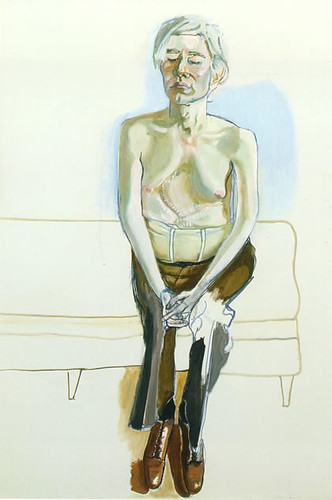
Foremothers in the Arts: Alice Neel


Women in the arts are continuously overshadowed by male artists. In every media women are put on the back burner. If you don't believe me, ask the Guerrilla Girls, or look up how many female artists are displayed at prominent museums compared to male artists. Like being an artist just isn't hard enough, the patriarchy is still there, making it even harder. That is why I have chosen to blog once again about another important artist to me, so to continue with this foremothers theme, I would like to introduce you to the dynamic Alice Neel.

Neel was born near Philadelphia in 1900, she studied at the Philadelphia School of Design for Women. In the 30's she lived in Greenwich Village, New York. With very leftist thinking and a strong social consciousness, she lived the life that I dream of. She painted dynamic portraits of Andy Warhol and Frank O'Hara. She supported black activists and was friends with leaders in the women's movement. She painted portraits of them during her time living in the Upper West Side. Neel received numerous awards, including the International Women's Year Award in 1976 and the National Women's Caucus for Art Award for outstanding achievement in the visual arts in 1979. Her nude portraits done during this time were ground breaking and completely unrestrained. Neel died in 1984.

Her self portrait is probably her most well known piece, I saw it a few weekends ago in the National Portrait Gallery (in the above right photo). She was unashamed of her body and age, which is rare. Her style is so influential and I used her as reference in my undergraduate thesis that I just finished last semester. In my thesis, I examined archetypes of women in Greek mythology. I wrote a paper and had a show of six paintings that represented six various goddesses. Neal was known for her unique way of illuminating "flaws". She illuminated the most prominent trait of her subjects. For example, if someone had a large and obviously prominent nose, then she would make it a large and definitive part of the piece. I used this technique when referencing a certain prominent part of the goddesses from either their physical description or myth, and making it obviously seen in the piece.

I love everything about her work, from her self portrait, to her earlier nudes, to the 1967 oil, Nancy and Olivia.

Thank you Alice Neel for living a fascinating life, sharing your art, and opening up the lines between feminism, political consciousness, and painting.

Victoria Woodhull - Ahead of her Time

In 1872, 48 years before women earned the constitutional right to vote, one woman launched her campaign for the US presidency. Though her presidential bid was unsuccessful, Victoria Woodhull, had taken a remarkable leap towards equality for women. A fierce advocate for women's suffrage, Woodhull spoke before the House Judiciary Committee - the first woman to do so - and made a legal case for women voting. She argued that the 14th and 15th Amendments granted women full rights as citizens and that denying them the right to vote was unconstitutional.

Woodhull was also well-known as an advocate for free love. Though it was a controversial idea at the time, she felt that women should be able to have as many sexual partners as they so desired. During a speech in 1871, an audience member yelled out to her asking if she personally identified as a free-lover, to which she replied:

"Yes I am a free lover! I have an unalienable, constitutional, and natural right to love whom I may, to love as long or as short a period as I can, to change that love every day if I please! And with the right neither you nor any law you can frame have any right to interfere."

While we work this week to remember the women who helped shape our country, we should all take a moment to reflect on the unbelievable foresight and achievements of Victoria Woodhull.

Tuesday, June 30, 2009

Celebrating Our Foremothers: Jane Jacobs

If you haven't already noticed from some of my other posts, I love cities. However, the highly male-dominated field of urban planning is a lonely place for a woman. Jane Jacobs is an exception to this rule and a true leader in the urbanist movement (and an inspiration to me). Her attitude towards combating urban issues like poverty, crime and racism have greatly influenced how I see the problems faced by people who live in cities.
Jane Jacobs is an American-born Canadian urbanist, writer and activist. She was born in Pennsylvania in 1916. She studied at Columbia University's School of General Studies where she took courses in a wide range of topics including geology, zoology, law, political science, and economics.

In the 1950's and 60's, Jacobs really claimed her own vision as an urbanist. During this time she was instrumental in organizing grass-roots efforts in New York City to block Urban Renewal projects that would have destroyed local neighborhoods. One famous campaign Jacobs fought was in opposition to another famous urbanist, Robert Moses, and his building of the Lower Manhattan Expressway that have would divided local neighborhoods, which she was successful in stopping.

Jacobs is best known for her 1961 book, The Death and Life of Great American Cities, in response to US urban renewal policies of the 1950s. Unlike the mentality of the time to simply bulldoze and demolish crippling cities and neighborhoods, Jacobs advocated the end of zoning laws, which would help to create dense, mixed-use neighborhoods resulting in diverse and vibrant urban community. She went on to pen 6 more books including The Economy of Cities and Dark Age Ahead.

In 1968, Jacobs moved to Toronto where she quickly became a leading figure in her new city and helped stop the proposed Spadina Expressway. She was selected to be an officer of the Order of Canada in 1996 for her achievements in writings on urbanism. Additionally, the Community and Urban Sociology section of the American Sociological Association awarded her its Outstanding Lifetime Contribution award in 2002.

In 2006, Jacobs died at the age of 89. Although this very influential woman is gone, her ideas of how cities and neighborhoods should operate lives one. Through her work, she kept the citizens of the communities and neighborhoods she worked with at the center of everything she did.

Jacobs was an urbanist who cared about the communities, not just the big business cities. The principles she followed in her urban activism are some that I hope that I can also adopt in my role as an urban activist. Jacobs' philosophy on urban living affected the way I live my life to be a more aware and active member of my urban community. I participate in community activities like festivals and clean-ups, read my community newsletter and take a move active voice in discussing issues like infrastructure and schools than I ever did before.

Jane Jacobs is a real inspiration to women who want to find a voice in their urban communities and care about their neighbors and the cultural fabric of where they live.

FemNews: Susan B. Anthony

Happy Tuesday, everyone! And a happy 4th of July, in case I don't get to say it later! As you've probably noticed, this week Choices Campus blog is celebrating the foremothers of our country. Well, you can't really talk about women's history without talking about Susan B. Anthony. Anthony was a major force in the women's suffrage movement, and so we decided to honor her this week with a rap of sorts. Enjoy and take some time this week to celebrate the women who worked tirelessly to make a difference in the world!

Celebrating Our Foremothers: Kate Chopin

When I try to think back to the start of my involvement in feminism, ages ago that it was, I think that it had something to do with reading Kate Chopin's The Awakening in 10th grade. I have memories of a sort of revelation occuring. I'm not sure if the sky opened up, or if there were choirs of sweet feminists singing, but it certainly is my first memory of reading something that really got me thinking about what women's role was in society and how that pressure affects women's lives.

Now, the 4th of July is in a few days, and instead of celebrating George Washington and the "forefathers" of our country, I'd like to celebrate a woman that ignited a desire in me to fight back against what I think is unfair and wrong.

Kate Chopin, born in St. Louis in 1850, spent most of her life in Louisiana and that culture informed most of her work. Chopin's earlier work was well-recieved, but The Awakening, though beloved by myself and countless other feminists, essentially destroyed her career. Chopin shocked the "respectable" world with her "vulgar" story of a woman who broke out of her loveless and sad marriage to pursue her own desires. She died in 1904, and her work regained popularity after her death.

So, in honor of a wonderful woman writer who dared to write about topics that were considered inappropriate at the time, let's all dust of our copies of The Awakening, or the collected stories of Chopin in my case, and take some time to celebrate someone who sparked a feminist fire in at least one women.

Celebrating Our Foremothers: Martha Ballard

Have you ever heard of Martha Ballard? Since we are making more of an effort to celebrate our foremothers here at FMF, I think it is fitting to celebrate the contributions of this 18th century midwife. Ballard acted as a midwife to the very small town of Hollowell, Maine, from the late 18th century into the early 19th century. You may be thinking, “Emily… A midwife? There have been midwives since there have been babies! What made her so special…”

Ballard is special in that she offers us a peek into the world of an 18th century midwife through her meticulous diary entries. In fact, her diary entries have been turned into the book A Midwife’s Tale: The Life of Martha Ballard, Based on Her Diary, 1785-1812. The literate Ballard kept notes of each delivery that she performed for a span of 27 years. She wrote entries about the grueling commutes, and the perils of difficult deliveries. Can you imagine a crossing a near-frozen river in the middle of the night to deliver a baby? She also writes of the evolution of society and religion, various epidemics that claim lives in her town, and so much more...

In the back of her diary, she kept thorough notes about payments received and promised, as families would provide Ballard with a payment according to their means. She was a well-respected member of her town, and she delivered children to wealthy and poor families alike. Still unimpressed? In 814 recorded deliveries (and an estimated unrecorded 200 before she began the diary), Ballard lost only five mothers and 20 babies; it would not be until WWII that a delivery was any safer than Ballard had performed about a century-and-a-half earlier. I highly recommend picking up a copy of A Midwife’s Tale, as it totally changed my perception of midwifery, and it offers really interesting insights into the world of one woman who, knowing that no one else would tell her story, decided to do it herself.

If you have any questions or concerns, feel free to contact campusteam@feminist.org!

Celebrating Independent Women this Independence Day

As we make our way through the week and ever-closer to the 4th of July, the FMF campus team wants to take some time to reflect on key players in our nation's history - or herstory as the case may be.

Every year, we hear the same old stories of the "great men" who wrestled tyranny to the ground with their bare hands and brutish strength...and taa-daaa, here we are in all our perfected masculine glory! Buuuuuut maybe just maybe, there might have been a few important women along the way, too. (Ya think?)

So, throughout the next few days, keep an eye out for entries on some of the amazing women who have strengthened the United States. Hopefully you'll learn something new about our amazing foremothers - and feel free to email us (campusteam@feminist.org) if we've not yet written about your favorite heroine in our nation's herstory!

Who knows, maybe after 233 years of patriotism, we can finally, proudly proclaim some matriotism this 4th.

Thursday, June 11, 2009

This Day in History: "Ladies running about the streets..."

A special thanks to AAUW and Feminist Majority's Norma Gattsek for this great bit of our Nation's history...

June 11, 1870 - On this date, the House narrowly passed an amendment to an appropriations bill prohibiting gender discrimination in the compensation of clerks hired by the federal government. Under the prior law, female clerks earned less than half the salary of similarly employed men.

The bill’s final passage (78 to 74, with 78 Members abstaining) reflected the contentious debate surrounding the measure. In February, Samuel Arnell of Tennessee first suggested that female clerks be paid an equal wage; the House rejected his and similar amendments amidst sarcastic barbs and jeers. Representative Anthony Rogers of Arkansas objected to “these ladies running about the streets and lobbying with members,” predicting that “the upshot of it…will finally place the whole administration of Government under female management.”

Representative John Farnsworth of Illinois countered “that it is unworthy the manhood of this House and the spirit of the age” to pay women lower wages. Other Members noted that many working women were Civil War widows whose wages were their only means of support. The Senate eventually amended the bill to include an equal pay clause. When the measure returned to the House, the Appropriations Committee adopted the Senate amendment; however, the committee effectively weakened it by adding language promising the equal wages only to future employees and by freezing the number of clerkships on the payroll.

The compromise lured support from Members originally concerned about the additional cost of the pay raises, tipping the scale in the close vote. Supporters were optimistic about the amendment’s future effect. “What we call civilization from age to age has brought to man wider freedom, yet little relaxed the iron subjugation of women,” Arnell intoned. “I see in the removal of this disability immediate reform in our social life.”

Source: http://clerk.house.gov/art_history/index.html

Keep hope alive. Don't give into hate.

After yesterday's tragedy and a week and a half of grieving for Dr. Tiller, I have been feeling a bit blue. Sometimes it seems like there is so much hatred in the world, and there is so little we can do.

But we can never give up, and never let hatred and anger overtake us. We are activists, and we must work to make this world a better place. In the words of my heroine, civil rights leader Ella Baker:

"You have to go back and reach out to your neighbors who don't speak to you, and you have to reach out to your friends who think they are making it good, and get them to understand that they, as well as you and I, cannot be free in America or anywhere else where there is capitalism and imperialism, until we can get people to recognize that they themselves have to make the struggle and have to fight for freedom everyday in the year, every year, until they win it."

Friday, May 8, 2009

Throwback! The Early Days of Roe v. Wade


Sometimes I get so caught up in the battles we face as activists today that I forget about some of the struggles our foremothers faced back in the early days of the feminist movement. Too often we think about the history of our movement during the "designated" times (Black History Month, Women's History Month) or because of special anniversaries, when we should actually consider our activism as part of a continuum. That way, we can be innovative and progressive while we simultaneously think back on the work and contributions of those who came before us.

My awesome feminist sister found a crazy relic from the early days of Roe v. Wade while doing a research project at Barnard. Meet "Abortion Eve," a comic book heroine trying to decide whether or not to have an abortion. While it is certainly a little dated, it is a revealing look at abortion in 1973 and is pretty brilliant at times:

"Scientific research shows that certain groups of people are immune to this dreaded affliction [unplanned pregnancy]. For example: not one President of the United States has ever been known to suffer from it. In all the wars which our proud country has known, not one General of the Army, Admiral of the Navy, or even a lonely helicopter pilot has ever contracted this malignant plague... You may ask who, then, is it that suffers the most? For some strange reason typists do, as well as nurses, secretaries, welfare mothers, and sopranos. Even some well known actresses and athletes have fallen victim to it. Extensive analysis shows the one common denominator in people who have an unplanned pregnancy: THEY ARE ALL FEMALE!"

Love it! Take a look, this is totally fascinating for feminist history nerds like me. Another one of my sister's finds: What Now?! Under 18 and Pregnant, a guide written by and for teenagers in 1977. We need more honest talk like that and less preaching nowadays, don't you think?